Nebraska ~ by Todd Clay Stuart

Nebraska in October. Autumn winds are the collective breath of a thousand withering corn fields. I think of home, I think of my older sister, her brown lossless eyes, her hair, the color of dried cornstalks, straight as a carpenter’s level. I’m ten and she’s sending me to go find her fingers, sliced straight off by the mower blade of the smallest of our John Deere tractors. She’s walking toward our farmhouse at her usual everyday pace, like she’s going out for ice cream or to get the mail. I need ice, she says. Go find my fingers. Hurry, she says. I run to the tractor. I look. I look everywhere. I get down on my hands and knees. The grass is thick and bloody. My hands and forearms are bloody too. I climb on the tractor, try to start it, try to move it, but I don’t know how. I want to scream, I want to disappear, but mostly I just want to cry. She’s my sister. My only sister. She holds her hand out to me. It’s ok. We have to go now, she says. And all these years later, when I visit the old farm, I still hunt for Beth’s fingers, along the edge of the field, left out there somewhere, alone, like a shriveled pair of cornstalks missed in the harvest.

***

Todd Clay Stuart is an emerging Midwestern writer. He studied creative writing at the University of Iowa. Recent work of his appears in New World Writing and Flash Fiction Magazine. He lives with his wife, daughter, and two loyal but increasingly untrustworthy pets. Find him on Twitter @toddclaystuart and at http://toddclaystuart.com.

The Balloon Retriever ~ by Alexandra M. Matthews

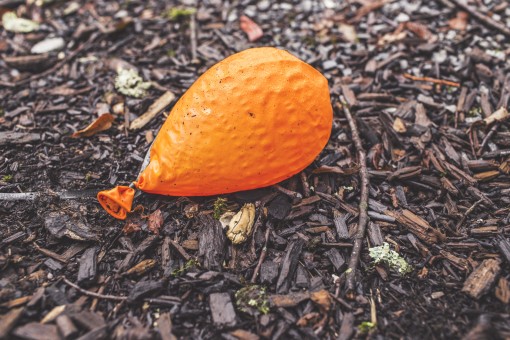
The Balloon Retriever builds a Balloon Girl in secret. During her lunch breaks, she works in a shed at the edge of the Balloon Park, where there’s a breeze and the mild smell of latex. Today she uses leftover balloons from the Jungle Cats exhibit to make a pair of Mary Janes.

The Park frowns upon balloon people because they tend to look more like clowns. Real people don’t enjoy seeing themselves that way, freakish and monster-like. They want to seem stronger, or kinder, or more attractive than they are. But if the Balloon Girl resembles a real one, the Head Curators might change their minds. They might bring the Balloon Retriever on for an exhibit or two. Perhaps they would stop calling her the Balloon Retriever.

            When the town began issuing fines for every balloon that escaped the park, the Balloon Retriever became a fulltime employee and was given a red pickup with balloon animal decals on the sides. It’s the first fulltime job she’s had since getting kicked out of high school for being pregnant, even though it didn’t stick. That was four years ago. Her official role is Groundskeeper, but everyone knows her as the Balloon Retriever. She doesn’t care for the nickname. It’s not as if she’s one of those alpine mountain rescuers who digs survivors out of the snow after an avalanche. Most of the time, a balloon ends up in a tree on the park grounds.

Among the permanent exhibits, there’s the Rose Garden, Jungle Cats, Antarctic Life, and Barn Animals. The newest exhibit is a fairytale-style Candy Cottage. Guests used to be able to walk through it, until one too many kids tried to eat a balloon gumdrop off the doorframe. Now the house sits empty.

The Balloon Retriever knows a thing or two about emptiness. She doesn’t plan to work at the Balloon Park forever, cleaning up after everyone else. She dreams of creating something in this life, of making her own messes.

With her shoes on, the Balloon Girl is complete. The Balloon Retriever brings her outside in the sunlight, tying one foot to the door handle for safe measure. In the wind, it looks like the girl is twirling herself around in her blue dress.

Before her next shift, the Balloon Retriever will seat the girl atop the slide next to the Candy Cottage, looking out over the park like the Balloon Retriever from her ladder.

***

Using her extendable grabber, the Balloon Retriever plucks a runaway penguin from the branches of a red oak. Following protocol, she makes small punctures just above the knots and releases the air slowly, so as not to startle the park guests.

The Head Curators were not pleased with her stunt. That was the word they used when they found the Balloon Girl. They were, however, impressed with the Balloon Girl’s likeness and granted her a trial period. If a week goes by without a single negative comment from a guest, they said, the Balloon Girl can stay, and they could discuss adding a sister. Every day this week, the Balloon Retriever has eaten her lunch on the bench across from the Candy Cottage, listening for a child’s squeal of delight at the sight of the Balloon Girl.

While she waits for the penguin to deflate, her radio beeps. A little boy tried to climb up the slide, causing the Balloon Girl to come untethered. She’s now gliding over the park toward the highway.

The Balloon Retriever cuts through the field in her pickup and barrels out the park entrance to try to head off the Balloon Girl. Swerving into the left lane, she floors it down the highway.

She is entranced by her airborne creation. She has never seen a balloon drift so impossibly far. The Balloon Girl will not survive the climb, she knows this. When the Balloon Girl gains enough altitude, the helium will expand until the pressure is so great, she pops. The prospect of losing her pains the Balloon Retriever, like watching a part of herself float away.

Yet in her final moments, the Balloon Girl will be the only balloon child to have reached such heights. A real child couldn’t do what her Balloon Girl can. A real child didn’t bring the Balloon Retriever such joy.

The Balloon Retriever collects herself and presses on. Eyes on the sky and grabber at the ready, she will recover the Balloon Girl, wherever she lands.

***

Alexandra M. Matthews is a teacher and writer living in the Hudson Valley. Her flash fiction appears in Jellyfish Review, X-R-A-Y Literary Magazine, Barren Magazine, Atlas and Alice, and Fractured Lit.

Before the Election ~ by Patricia Q. Bidar

Like Judy in the movie, you are a fallen woman. At home, men follow you in their cars. They form and change you. They see themselves as rescuers. When the rescue attempts fail you are left for the next one to dress and paint you.

On Third Street, in front of Doña Esther’s, you exit the car, pulling the back of your skirt away from sweaty flesh. Discarded pandemic masks are banked against the doors of the businesses, all closed.

An old man blocks the door of Doña Esther’s. He is stooped and skinny. He wears a battered t-shirt that reads “The First African American President of the United States.” Once he and you shared a feeling: excitement that Barak Obama had been elected president. President of the United States. But he is not the president now. He will not be the president again. The man regards your damp dress, your white go-go boots.

“What do you think you’re doing?” There is no seduction in this question. But there is no disapproval, either.

“I’m here for … the banquet. The one with the Halloween puppets.”  Afterward, you usually visit the mission to pay your respects to the Amah Mutsun buried there. Then you cool off and catch your breath in the red velvet sanctuary, under the gazes of wooden saints.

Jimmy Stewart has vertigo because of his guilty conscience. A policeman died because of him. He throws himself into the annihilation of height. A dreamed grave. The spiral hairdo of a woman whose personality he erases. A woman who startles at the sight of a nun, and plummets to her death.

The Vertigo Effect is achieved by zooming in fast, while pulling the camera back at the same time. You also get this feeling when you’re old, when looking up can throw you off kilter. Or when you observe an old man resting his hand on his hip-sheathed knife. A leather sheath, stamped with poppies. Like those barrettes and hard purses you used to see in the seventies.

The door to Doña Esther’s is locked. Earlier, you called. You chalked the unanswered phone to a busy lunch hour, and set off. Inside, you see the arched interior doorways. Long shadows streak the dining room’s red walls. You register the smell of something burning. Something that isn’t food.

“What do you want?” you ask him.

“My teeth. My work. My family,” he answers. “This restaurant was supposed to be a polling place.” This is a man who has felt pride. Who once stood tall, with a strong and lively skeleton inside him. Worked. Sired children. Are they safe now, these children?

Behind the man are the three chickens. They scratch and murmur. Far below, your boots are dulled with dust. The man is not as old as you first thought. He has no fingernails, you notice, zooming out and zooming in. He smells of sweat and lilac. His t-shirt is stained with a red sauce.

From inside Doña Esther’s comes the sound of a ringing phone. The bright echo of those rings hangs in the hot air. You and the old man stand there on the turning earth, not far from the San Andreas Fault. All around the two of you, the sky pulses purple.

***

Patricia Q. Bidar is a native of San Pedro, California with family roots in New Mexico, Utah, and Arizona. Her stories have appeared in Wigleaf, The Pinch, SmokeLong Quarterly, Sou’wester, Little Patuxent Review, and Pithead Chapel, among other places. Apart from fiction, Patricia ghostwrites for progressive nonprofit organizations. She lives with her DJ husband and unusual dog in the San Francisco Bay Area and tweets at @patriciabidar. Visit Patricia at www.patriciaqbidar.com.

Hibernation ~ by Derek Heckman

Like most things now, it began as a meme.

Ashleigh Weingarten (@ashashbaby) posted a photo of herself biting a cheat-day cheeseburger and branded it with the caption Getting Ready for Hibernation.

In that way particular to memes and saints (right person, right place, right time, right witness) Ashleigh’s joke caught fire online and the format began spreading around the internet like rumor. People started posting larger and larger meals—nachos and steaks and great tureens of paella—and labeling them with hashtags like HibernationHereWeCome! Mukbang stars took up the challenge with gusto, calling out their friends and trying to top each other back and forth. A sorority in California filled the vases in their common room with foil-wrapped bouquets of burritos, while a broker’s office in Tokyo outlined an entire parking lot with baskets of steaming dumplings.

For hibernation we all laughed! and then suddenly realized we were serious.

The food, after all, was all being eaten. The jokes, after posting, were consumed. Veggie stir fries, and avocado bowls and plate after plate of full English breakfasts were being scarfed down continuously all around the world. Nuns and rabbis and frat boys doing service hours met up in parks to cook barrels full of soup, serving whole warm vats to the needy along with claymore-sized baguettes. Neighborhoods swelled and homes crisscrossed as families began inviting each other for potluck feasting every night.

If bears did it, if trees did it, if we—before the building of cities, before the coming of Henry Ford—had moved more with the seasons, had slept when it got dark, then why not now?

At what point, we asked ourselves, had we decided this was a bad idea? 

We became obsessed with all things fatty and deliciously protein-packed, with building the store of calories we’d take with us into the dark. Weight-loss content became entirely the opposite: Hollywood-gorgeous men and women telling their followers how to pack on the pounds.

When the first snow fell, we sighed to each other happily, knowing it was time. It felt good to finally be doing this, to give into the pull of the earth and nature, to reject caffeine and the drive to produce, to finally lay down for a while and at long last take a rest.  

The 1% wasn’t especially happy. Gone was their work force, off to bed for the next five months. They yelled about the economy, the stock market, Atlas Shrugged. We hung signs on the factories and slapped each other warmly on the back. We left them out there, yelling, the snow piling, the sky growing black.

We pulled the blinds and burrowed in, put on podcasts and YouTube videos, 4000 hours of rain sounds. We all breathed out together, warm and safe, some already snoring.  

We listened to the creaking of the universe.

We slept.

We dreamed of spring.

***

Derek Heckman was born in Peoria, Illinois, and holds an MFA in fiction from the University of Montana. His work has been published in Embark Journal, Ellipsis Zine, The Collapsar, and Wigleaf, and was also featured in the anthology “Teacher Voice” from Malarkey Books. He currently lives in Boston, Massachusetts, and you can find him on Twitter as @herekdeckman.

How to Become Fictional ~ by Ashley Hutson

The drain gurgled. The husband kept telling her the drain did not gurgle. The drain was fine, he said. Must be her ears. She lifted up the wire strainer and they stared into the pipe together. It’s not gurgling! the husband said. All day she would hear it. He was sure it was fine, though. Pretty soon the husband told her there wasn’t running water, the sink didn’t exist, there wasn’t even a house. They lived in a palace! And it was filled with sunlight and love and clean corners. Keep telling me, she said. I don’t see it. That’s because her eyesight was failing, he explained. 


At the end of this story is a woman with no eyes, no mouth, no nose, no fingers or toes. And she lives on the moon. The end.

***

Ashley Hutson’s writing has appeared in Granta, Electric Literature, Wigleaf, Fanzine, and other places. Her debut novel is forthcoming from W.W. Norton. She lives in Sharpsburg, Maryland.

Anaphora (Ten Ways to Greet a Time Traveler) ~ by Annika Barranti Klein

One.

Plato was not terribly surprised when the time traveler arrived. There was something otherworldly and strange about the mountaintop where the time traveler appeared. Plato had always known something would happen there. Now he knew what it was.

#

Two.

Plato was not terribly surprised when the time traveler arrived. He knew that they would ask him on an adventure. He knew he would go on the adventure and it would be a disaster, so disastrous that the time traveler would travel back further, to last year, and warn him to say no to the adventure. Beg him, plead with him, cajole him to please, please say no. Their eyes were wild as they explained. He knew they had seen terrible things. He knew the adventure would bring him to his end. But he also knew that he had to say yes, because if he said no, the time traveler would not have come to warn him.

#

Three.

Plato was not terribly surprised when the time traveler arrived. At the time, Plato was angry at his philosophy teacher, Socrates, who is credited with the conceptualization of irony. Plato had lost track of time when the time traveler appeared, which he would have considered ironic were he speaking to Socrates. As it was, when the time traveler invited him on an adventure, he told them yes without hesitation.

#

Four.

Plato was not terribly surprised when the time traveler arrived. He had seen this before, as a boy. He had been waiting.

#

Five.

Plato was not terribly surprised when the time traveler arrived. Perhaps he should have been. He’d never considered the possibility of time travel before, but as his great teacher Socrates was fond of saying, he knew that he knew nothing. Sometimes Plato repeated this—I know that I know nothing—with a little rhythm, like a song that he sang to himself. He knew nothing, and therefore he knew that time travel was just as possible as anything else. “Welcome,” he told the time traveler.

#

Six.

Plato was not terribly surprised when the time traveler arrived. One is rarely surprised when one is living backward in time.

#

Seven.

Plato was not terribly surprised when the time traveler arrived.

“Socrates,” he called. “He is back.”

“Which one?” Socrates asked.

Plato shrugged. The time travelers all looked the same to him.

#

Eight.

Plato was not terribly surprised when the time traveler arrived. Time, he concluded, was a loop. No sooner did he return home from adventures through time than the time traveler arrived again. They never remembered him. They never remembered their adventures. It was always the first time for the time traveler. Plato thought that it ought to be the other way around, but he knew that he knew nothing.

#

Nine.

Plato was not terribly surprised when the time traveler arrived. He should have been surprised. It was a very surprising thing. But he felt no jolt of surprise. He merely saw the time traveler and thought, ahh. The time traveler has arrived.

#

Ten.

Plato was not terribly surprised when the time traveler arrived. He had been waiting. He had been waiting, and hoping.

“You came back,” he said to the time traveler.

“I have never been here before,” the time traveler assured him.

“I see,” Plato replied. “But you will. In my past, and your future, you will come and ask me to travel through time with you. I will say no. But I will regret it until you come and ask me again, in your past and my future.”

“You mean our now?” the time traveler asked.

“Yes,” Plato answered.

***

Annika Barranti Klein is a writer in Los Angeles and a contributing editor at Book Riot. Her fiction can be found in Craft Literary and Hobart After Dark, and is forthcoming in Asimov’s. She is currently knitting socks instead of working on her novel.

Cruise ~ by Anthony Varallo


The world is filled with so many people we will never know; everyone on this ship, for example.  See the family in matching T-shirts and sun-visors, the visors topped with cat’s ears.  Or the same child who keeps running the length of mezzanine at full speed, his clothes soaking wet from some source we cannot name.  The pool, most likely, although the pool is crowded with children riding the backs of parents, the parents affixed to straws noisily asked to convey the last of margaritas, mojitos, and Mai Tais to grateful mouths.  Attendants in neckerchiefs roll trash cans in from wherever and out to wherever.  Walking to obtain yet another self-serve ice cream cone, we bump into eleven new strangers, our only bond our habit of saying “sorry” at the same time.  Why do we want another ice cream cone?

            Surely this cruise was someone’s idea.  Someone—us, most likely—had to pay for all of this.  Which is probably how everyone else got here, too.  Pricey, we figure.  It had to be, otherwise how would we get the opportunity to watch so many “Broadway-quality” shows with so many agreeable people we’ve never known?  This one is top-shelf all the way, what with its seamless blend of acrobatics, rollerblading, and Sondheim tunes.  We’re either in awe or a little bored or maybe both; it’s hard to say with our ears ringing from the applause of strangers.  We’d add ours to the din, but our hands seem to be occupied by ice cream cones.  When did we get those?

            We tour the ship, hoping, we suppose, that we’ll turn the next corner and see someone we recognize.  Someone to return the world to the one we know.  But the world we know seems to have been commandeered by the world of strangers, who pass us by at an alarming rate.  The teenager in the neon top that proclaims MONOGAMY ROCKS!  The octogenarian in a wheelchair festooned with orange flags.  Not three, not four, but five adults cheerlessly dressed as Santa Claus, for reasons we’ll never know.  A white dog, apparently ownerless, fervently licking a fallen ice cream cone from the shuffleboard court.

            We ascend stairwells teeming with passengers headed the opposite way. 

            “Sorry!” we say.

            “Sorry!” the passengers say.

            We reach the promenade deck, where so many people we do not know stand shoulder to shoulder, staring out across the flat expanse of ocean.  The sun, that old standby, mysteriously hides behind thick clouds that threaten rain.  Should we speak of the weather to the couple next to us, each of them taking selfies?  Should we make small talk?  But, wait, the clouds part.  The darkness fades.  The sun re-emerges and permits us to see something we hadn’t noticed before: another cruise ship, exactly like ours, riding the horizon.  Those familiar funnels, those unmistakable masts.

            “Hello!  Over here!” we shout, and wave along with everyone else at what surely must be people just like us.

***

Anthony Varallo is the author of a novel, The Lines (University of Iowa Press), as well as four short story collections.  New work is out or forthcoming in The New Yorker “Daily Shouts,” One Story, STORY, Chicago Quarterly Review, DIAGRAM, and The Best Small Fictions 2020.

White Noise ~ by M.J. Iuppa

Deep in the belly of the furnace kicking on is the sound of winter. The farmhouse’s breath becomes cold and dry, making her wear two layers of clothes, especially wool socks to skim across the wooden floors, raising enough static electricity to stand every hair on her head on end. She likes to feel the tiny bristles rub against her palms, thinking her cap of white hair will be back by spring, if she survives whatever else might kill her.  She can still amp up her heart rate until she hears her private sea shushing back & forth, like snow.

***

M.J. Iuppa’s fourth poetry collection is This Thirst (Kelsay Books, 2017). For the past 32 years, she has lived on a small farm near the shores of Lake Ontario. Check out her blog: mjiuppa.blogspot.com for her musings on writing, sustainability & life’s stew.

Medusa’s Bridesmaids ~ by Jo Withers

Are careful not to style their own hair, realising chignons and soft waves will cause the bride distress. Instead they cover their heads with silk scarves, each one a subtle cream, while the bride’s is threaded delicately with rose gold, trickled with amethyst stones.

Decorate the church with posies in lilac and pink, make everything traditional, knowing it’s the things she thought she’d never have that matter most. Give her something old/something blue with a shimmering scale snatched from Poseidon’s tail, crushed to midnight powder in a locket at her throat.

Don’t ask why she’s walking down the aisle alone, or mention their own families, the mothers who would hand-stitch their gowns, the fathers who hold them longer every time they see them, cherishing each fragile second as though they’re dandelion-down, knowing any moment they may blow away.

Hold her and tell her she can have the church and the pure white gown, enraged there is no virginal colour-coding for the groom. Tell her it was not her fault, say over and over that she did nothing wrong. This man is good, this time she will be happy. Cry with her when she trembles, tell her she is perfect, that no one has worn white like her.

Make her promise not to cut her hair. It will only grow back fiercer. Instead, they charm the snakes with lullabies, wind them into coils when they grow sleepy, remembering the first morning they found her, how she howled as they hissed, slicing at the snakes with scissors, serpent heads sprinkling the bedsheets, slicing at her arm with blades, wanting to cut away the shame, screaming that they mustn’t look, their eyes would burn, their hearts would turn to stone, but all they saw was pain, all they felt was love for her.

Have known her since she was a little girl, when her hair was saffron curls, when they practiced getting married in the garden, promised eternity to each other in breathless whispers, talking turns to slow-step down the pathway as the other girls threw daisies, squealing as they reached the end, projecting bouquets backwards to begin again, again.

Were the ones to teach her how to dance, giggling as they took her hand, twirling her beneath their outstretched arms, rolling her one step, two step, to the side, pressing their shoulders over her protectively, flinging her between them in dizzy pirouettes, catching one hand then another as she whirled awkwardly, then nervously, then gracefully, hair billowing behind, laughing, laughing, as they pulled her close, slowed things to an almost standstill, circling their arms around her as he will do tonight, hips swaying softly, not a wisp of space between them, looking down at her like she is blessed, looking down at her like she is whole.

Catalog of Small Things ~ by Quinn Forlini

She’d had a tiny baby. She hadn’t seen it. At least, not that she could remember. She thought there must have been a moment when the baby was leaving her body that she would have looked down and seen the top of a head, maybe a foot, or a lump held up to her in the arms of a doctor or nurse, in that unforgiving overhead light. But she remembered only the room and herself, and even that was in pieces, splinters of a body like close-ups in a movie. Her hand, clenched. The top of her stomach. A ceiling tile with little dots like pairs of eyes that looked like they were blinking.

Nobody had touched the baby. Not directly. Only through layers of gloves and blankets, and even that not very much. They tried to touch the baby as little as possible. She hadn’t touched it at all. The nurse with the cheeks that always looked like they were blushing told her the baby was being taken care of in another room. The baby had to be separated from everything and everyone as it gained strength. She was lucky to be alive. She, and the baby. The baby was also a she, but everyone called it the baby. 

The hospital sent her home, but the baby stayed.

She pretended that she didn’t have a baby at all, tiny or otherwise.

She took cold showers. She ate peanut butter sandwiches, drank chocolate milk, and watched re-runs of Bewitched. Maybe she could be a mother, after all.

She became obsessed with small things. She began cataloging them. Stamps, pennies, violet petals. A miniature porcelain statue of a cat. She found these things all over the house. She had never noticed them before, but now they seemed to jump out at her. She kept a photo album and in the clear, plastic sheets she slipped scraps of trash—movie ticket stub, ripped receipt, half-charred match. She couldn’t bear to throw these things away.

The baby arrived. Or, it was ready for pick-up. That’s what the hospital said on the phone. Or something like that. Of course they weren’t going to deliver it.

When she went with her mother to pick up the baby, nobody had ever held it. She was going to have to touch it. Of course. She stood in the hospital hallway just outside the room where the baby waited. She longed to be home, watching TV. She did not want to touch anything. She did not want anything to touch her. When her mother nudged her towards the door, she flinched.

The nurse lifted a bundle of cloth that most likely had the baby inside it, wrapped like a gift. The cloth held the baby the way she had held the baby inside her, only then it wasn’t a baby but sleight-of-hand. The nurse was passing the cloth to her, the cloth was heading towards her arms that did not know how to hold a baby. Maybe it was so tiny it would slip through her fingers. Maybe it would crumble in her hands, like a clump of dirt. Maybe it would disappear. Maybe the baby was not inside the cloth at all. Maybe the baby was not real. Maybe it was too small to be real. Yes, maybe it was too small.

***

Quinn Forlini has been published in The Greensboro Review, The Vassar Review, and The Journal. She received her MFA from the University of Virginia and teaches creative writing at Ursinus College.